
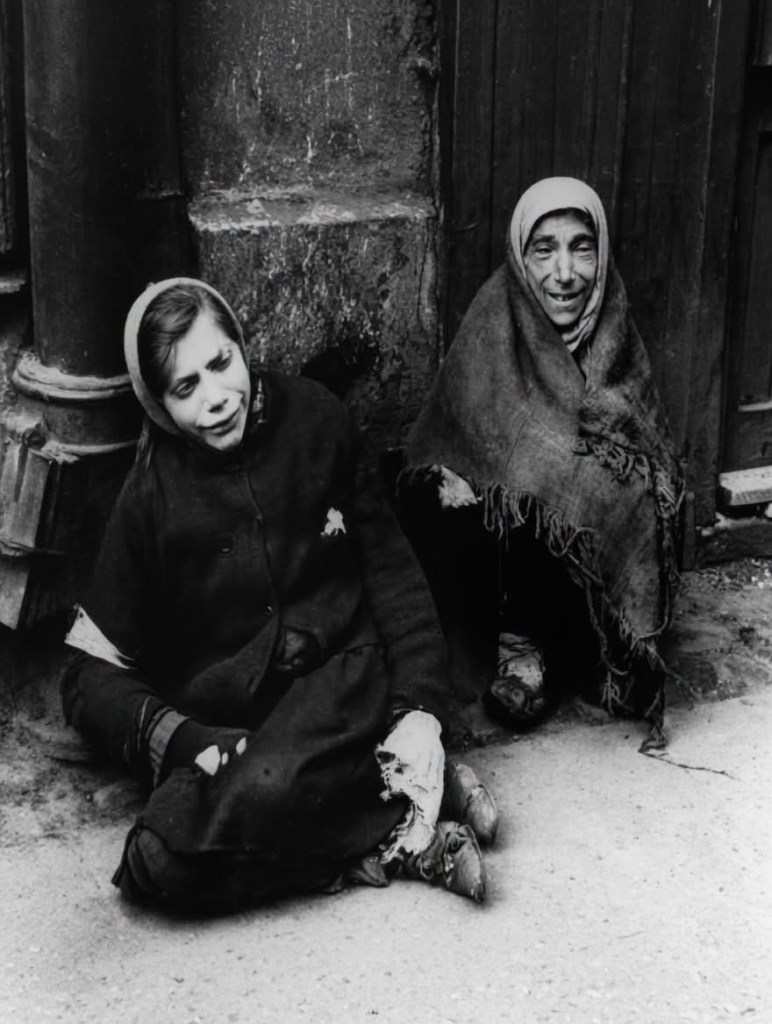
By the middle of 1941, more than 400,000 Jewish men, women, and children were confined inside the Warsaw Ghetto under German occupation.
The ghetto was sealed off from the outside world.
Food supplies were tightly controlled, and the official daily food ration allocated to Jewish residents was less than 200 calories per person—far below the minimum needed to survive.
Starvation quickly became one of the greatest threats to life inside the ghetto.
Children searched the streets for scraps of food.
Many were forced to beg simply to stay alive.
Photographs taken during this period—including images captured by German photographers for official purposes—unintentionally documented the devastating humanitarian crisis unfolding behind the walls.
Today, those photographs serve as important historical evidence of the suffering endured by the ghetto’s residents.
Despite the desperate conditions, acts of courage and compassion continued.
Jewish aid organizations, house committees, and soup kitchens worked tirelessly to feed the hungry whenever supplies could be found.
Children and teenagers also risked their lives by secretly smuggling food through gaps in the walls and hidden routes, helping sustain countless families despite the constant threat of arrest or death.
These efforts could not end the starvation, but they offered hope to many who had nowhere else to turn.
In the summer of 1942, mass deportations from the Warsaw Ghetto to the Treblinka extermination camp began, marking one of the deadliest phases of the Holocaust.
Today, the story of the Warsaw Ghetto stands as a reminder not only of immense human suffering, but also of the resilience, solidarity, and courage shown by those who struggled to preserve life under impossible circumstances.


You must be logged in to post a comment.