
Jennie Hansen — Titanic Survivor
Jennie Louise Hansen survived the Titanic sinking in Lifeboat 11, while her husband, Claus Peter Hansen, was lost in the disaster.
Photo source: The Vintage News
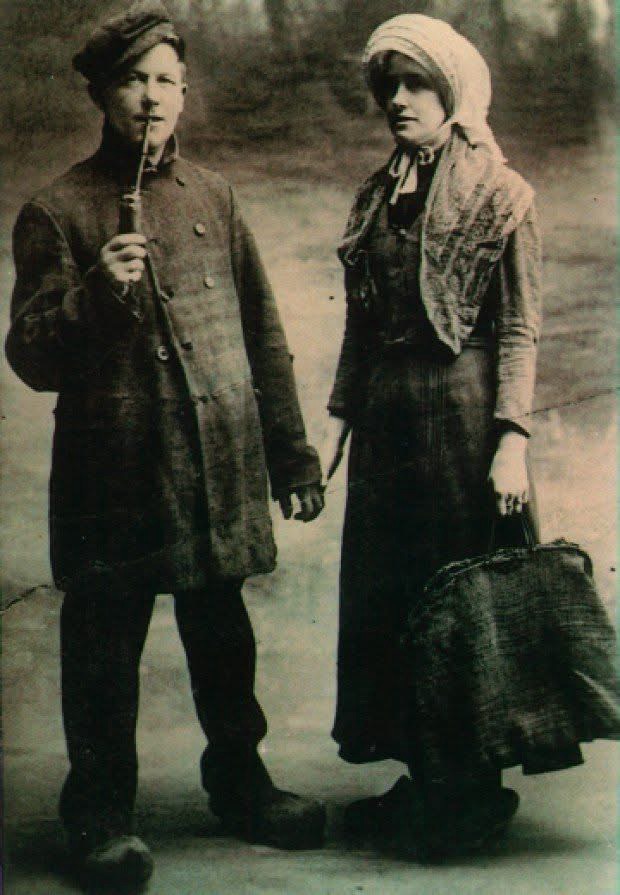

Madeleine Talmage Force Astor was an American socialite best known for surviving the RMS Titanic disaster in 1912 while five months pregnant. At 18, she married wealthy businessman John Jacob Astor IV, sparking public scandal due to their 29-year age gap. Widowed in the sinking, she later remarried twice, losing her Astor fortune upon her first remarriage. She remained a prominent figure in high society until her death in 1940.
Mistaken Identity
A FABRICATION, HALLUCINATION
OR CASE OF MISTAKEN IDENTITY?
In 1912, three months after the RMS Titanic sank taking the lives of nearly 1,500 passengers and crew, Peter Pryal was strolling down a street in Baltimore. It was an ordinary Wednesday in July, until he sighted something extraordinary.
Pryal was an elderly retired businessman who shunned the public limelight. He was well known and respected by the community, a churchgoer, a teetotaler and not given to flights of fancy. More importantly, given what transpired on this hot summer day, is that nearly 20 years earlier Pryal was the quartermaster aboard the RMS Majestic, one of several transatlantic ships owned by the White Star Line. The Titanic was the newest and brightest jewel of the White Star fleet until its demise in April.
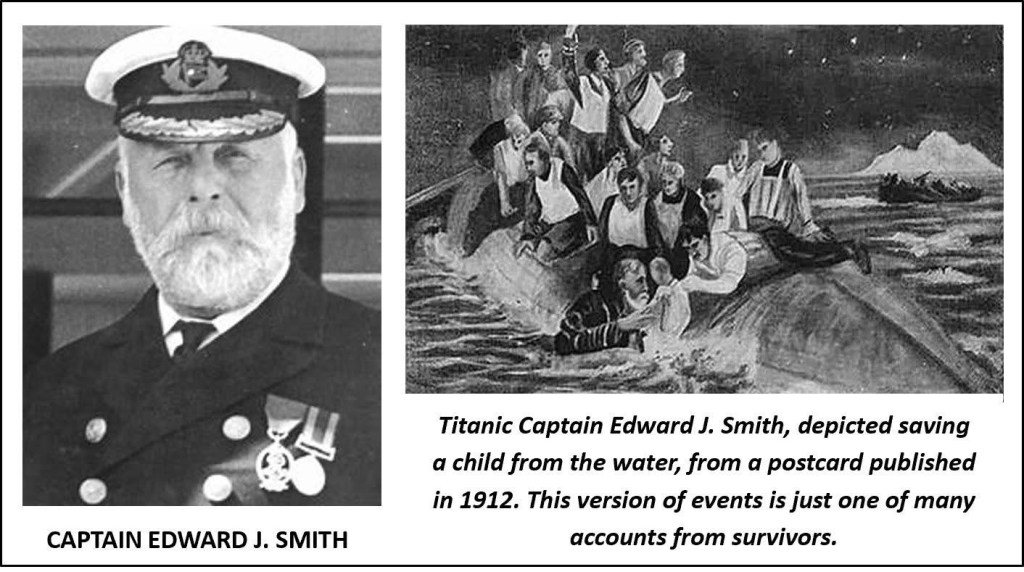
Pryal was shocked when he unexpectedly beheld a familiar figure walking towards him. This can’t be, he thought. However, Pryal was absolutely certain. It was Edward J. Smith, the commander of the Majestic when Pryal was a member of its crew. But how can what he is seeing be true? Smith was captain of the Titanic and died at 62 years of age when the ocean liner broke in two after striking an iceberg. Still, Smith’s body was not among the 377 that were recovered.
Smith was captain of the Majestic from 1895 until 1904. Pryal worked for the White Star Line for 17 years. Much of his tenure aboard the Majestic overlapped the time Smith commanded the vessel. The two undeniably knew each other well.
Pryal was on his way to visit Dr. Mactier Warfield for treatment on an internal disorder, according to a story in the Honolulu Star-Bulletin on August 3, 1912. Suddenly he spotted the visage of the man he once knew as his captain walking along Baltimore and St. Paul streets. The man was carrying two suitcases, wearing a light brown business suit, straw hat, tan shoes and staring straight ahead. Pryal approached him and spoke but received no reply. Perhaps startled that he had been recognized or that he was being pestered by a total stranger, the man continued walking away rapidly.
To confirm his belief that Captain Smith was alive, Pryal went to the same spot at 9 a.m. on Friday morning hoping to find the man again. After an hour wait, to his amazement he spotted the same man approaching.
Walking up to him, he said, “Captain Smith, how are you?” Then, according to Pryal, the man answered: “Very well, Pryal, but please don’t detain me; I am on business.” He had called Pryal by name!
So great was his astonishment, Pryal followed the man to St. Paul and Fayette streets. Several times the man turned. When he finally noticed Pryal was trailing him, he rushed into the Calvert Building and tried to lose himself in the crowd. Pryal managed to stay with him. They went through the Equitable Building.
Upon their exit, Pryal saw him board a west-bound streetcar on Fayette Street. He got on as well. Pryal continued his pursuit when the man got off at the Washington, Baltimore and Annapolis Station. There he purchased a ticket to Washington, D.C. As he passed through the gates to board his train, the man turned to Pryal, smiled and said: “I am on business. Don’t worry (about) me, Pryal. Be good to yourself, old shipmate, until we meet again.”
“There is no possibility I am mistaken,” Pryal later told reporters. “I have known Captain Smith too long. I would know him even without his beard. I firmly believe that he was saved, and in some mysterious manner brought to the United States. I am willing to swear to my statement.”
Of course, he was aware of the consequences of going public with the story. “People will say I’m either a second-sight man or insane; but they are mistaken. I simply believe the evidence of my eyes and ears.”
Contacted by the Washington Herald, Pyral’s physician said his patient was suffering from nervous shock triggered by the experience, but that he is “absolutely sane.”
Asked how it was possible for Smith to escape death in the frozen waters of the North Atlantic, Pryal offered the following scenario: “It would have been an easy matter for Captain Smith to have gotten into a lifeboat as a passenger and, knowing as he did, the proximity of barren islands, might have, under difficulties, of course, made his way there and thence to Cape Sable. I know that he is alive and that I saw him. I would know him anywhere under any circumstances.”
An article in The Daily Telegraph (Sydney, Australia) on July 24, 1912 referred to Pryal as “a veteran Montreal captain” and “a lifelong friend of Captain Smith.” It also claimed the Titanic’s master was staying with his “nephew, a Baltimore resident, (who) disappeared the day after his uncle’s alleged reappearance.”
Pyral’s story was received with incredulity at the London office of the White Star Line. “We have heard nothing to indicate that Captain Smith did not meet death when the Titanic went down,” said the manager. “This Baltimore captain’s story must be either the result of delusion or mistaken identity.”
Suspicions were also raised by a story that had appeared in The Mahoning Dispatch (Canfield, Ohio) on January 23, 1914 in which Pryal revealed he was the beneficiary of a miracle: “In answer to his prayers to the virgin mother for two years, a cancer on his nose from which he has suffered for the last 27 years has been cured, declares Peter Pryal, aged 72. The old man said he retired one night, and on awakening he discovered that the cancer, which had been eating its way into his left eye and into his brain, had been cured. Pryal discarded the shield which he has worn over his nose for years and the skin of the nose was perfectly dry.”
Some readers wondered how much a cancer that had been eating into his eye and brain may have influenced Pryal’s vision of Captain Smith six months later.
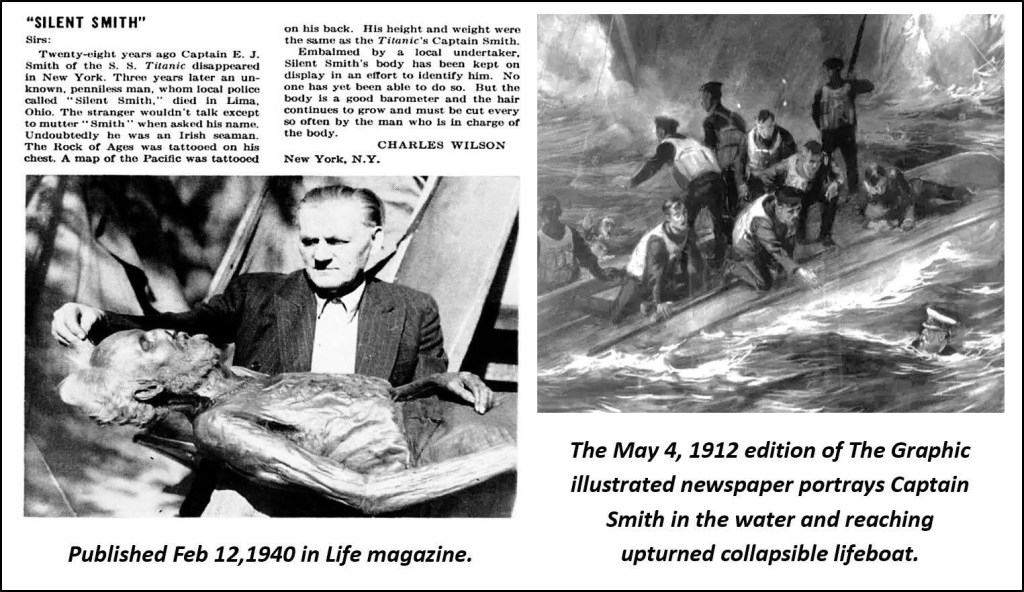
Regardless, the possibility that Smith actually survived the Titanic was resurrected in 1940 when a letter in Life magazine suggested the captain had ended his days as an elderly derelict in Lima, Ohio, known only as “Silent Smith.” Among the purported evidence: The man had arrived in town three years after the Titanic disaster, would only give his name as Smith, was about Smith’s age and size, and bore the sort of tattoos common among seafarers. Life seems to have been unaware that immediately after Silent Smith’s death in 1915, the Lima News identified the man as one Michael McKenna.
(Robert DeSando is a former journalist and author of the book “A Titanic Loss for New Jersey” available at amazon.com and barnesandnoble.com.)

Restored unreleased photo of Ruth Elizabeth Becker
(October 28th, 1899 – July 6th, 1990). she was a Second Class passenger of the Titanic. She survived the sinking and became one of the last survivors to die. She was the daughter of American Lutheran missionary Allen Oliver Becker and his wife, Nellie.
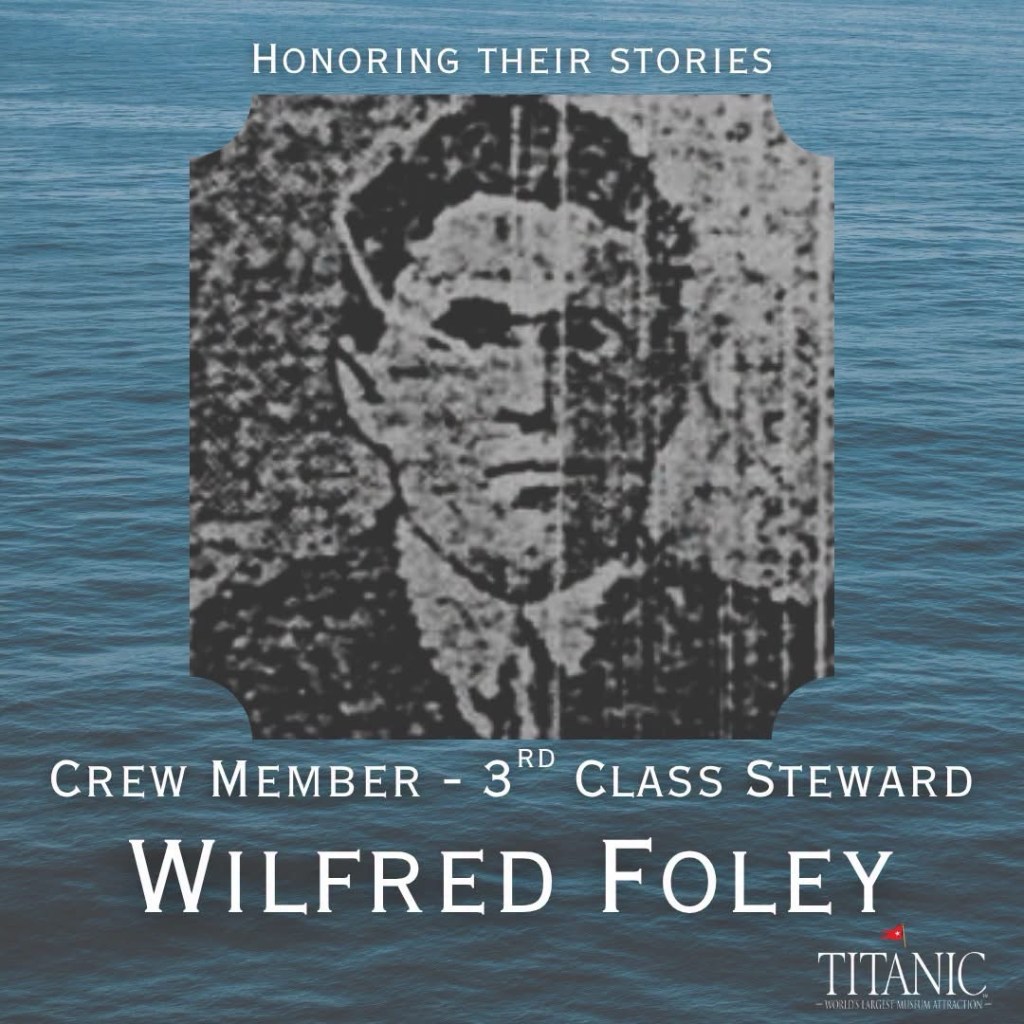
Wilfred Foley, born 9 May 1890 in Swansea, Wales, worked as a third-class steward aboard the Titanic. He survived the disaster, likely in lifeboat 13, though early reports mistakenly listed him as lost. After the voyage, he returned to Britain, never married, and later enlisted in World War I but was discharged due to tuberculosis. He died on 3 April 1916 at age 26 and was buried in Eltham, London.


You must be logged in to post a comment.